About the author

about the author…
Barbara Quick is a graduate of the University of California at Santa Cruz (UCSC), where she majored in English with a minor in French. While a student there, she served as an undergraduate teaching assistant for two different professors, in Classics and English, as well as a research assistant for two years in the French Department. Barbara was awarded second place in the Ina Coolbrith Memorial Poetry Prize competition for the best unpublished poem or group of poems by an undergraduate student in California.
Barbara’s first piece of journalism was published during a nine-month-long stay in a borrowed cottage made from the stones of a ruined 18th century watchtower in rural West County Cork, Ireland, where she wrote, froze and lost an alarming amount of weight. (When one of the local farmers passed her on the road and wanted to give her a compliment, he’d say, “Gee, you look fat today!”)
Following her stint as a starving writer, Barbara settled in Berkeley, California, where she got an entry-level job at the University of California and continued to write poetry, some of which was published in various literary journals. Over the course of six years at UC Berkeley, she worked her way up the editorial ladder to a senior level position. She spent two field seasons as a volunteer in remote Arctic Alaska with a group of bird biologists, helping with a census of kittiwakes and murres, writing detailed notes about the landscape and storing up impressions for what would become her first novel. In 1987, she married filmmaker John Quick, lived with him on a sailboat, spent half a year in Budapest, and turned her hand to fiction.
It took Barbara ten years and thirteen drafts to write her first novel, Northern Edge. The book won the Discover: Great New Writers Prize when it was published in cloth by Donald I. Fine in 1990. There were jacket quotes from Ursula LeGuin and Jessica Mitford. The novel was brought out in paperback by HarperCollinsWest in 1995 and optioned for a film in 2007. Barbara was a featured speaker shortly after the book’s publication at Literary Women: The Long Beach Festival of Authors. She became a frequent reviewer for the New York Times Book Review and had a MyTurn essay published in Newsweek (“Tales from the Self-Help Mill”) on August 31, 1992, a couple of months before giving birth to her son Julian. Thomas Middleton published an acrostic puzzle in Harper’s that had “Northern Edge by Barbara Quick” as its solution.
Following an amicable separation in 1997, Barbara wrote two pop psychology books over the course of the same number of years (Still Friends: Living Happily Ever After… Even If Your Marriage Falls Apart, fromWildcat Canyon Books, and Under Her Wing: The Mentors Who Changed Our Lives, published by New Harbinger. During this time, from 1998-2000, she ran an international boardinghouse and took up Brazilian dancing. In 2005, with co-author Matthew McKay, PhD, she wrote The Commitment Dialogues (McGraw-Hill, later translated into Spanish) and teamed up with artist Liz McGrath to write the bilingual children’s picture book, Even More/Todavía Más (Raven Tree Books).
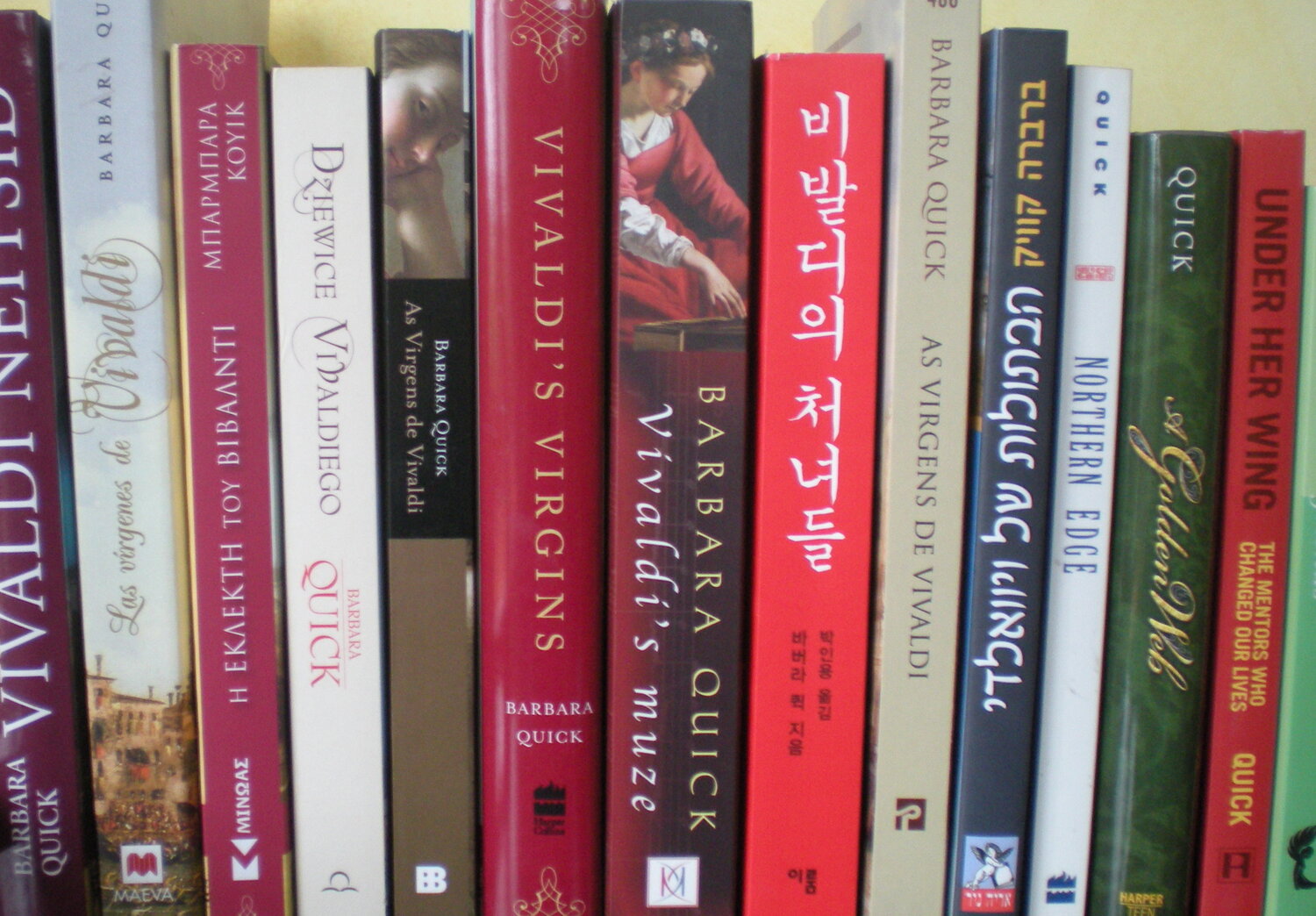
To properly do the research for her second novel, Vivaldi’s Virgins, Barbara studied Italian and made several trips to Venice, where she dug in the archives of the Ospedale della Pietà, the foundling home where Antonio Vivaldi was resident priest and composer. The novel was published in cloth by HarperCollins in July 2007, and launched as a paperback reprint in 2008. Translations of the novel were published in Holland, Spain, Russia, Israel, Greece, Brazil, Portugal, Estonia, Poland, Romania, Albania, and Korea. Vivaldi’s Virgins was named one of the 10 best books of summer by Redbook, was included on Barnes and Nobles’ Summer List, chosen as a Notable Book for August by BookSense, was an Editor’s Choice for the Historical Novels Review, and was named the best novel of 2007 by the Monserrat Review. Still in print after nearly 20 years, the novel is a frequent book club choice, is available as an audiobook, and is featured on a number of school and library reading lists.
Barbara’s next project was a young adult novel set in 14th century Bologna, about the western world’s first female anatomist, Alessandra Giliani. A Golden Web, acquired by Rosemary Brosnan, was published by HarperTeen in 2010 and translated into Indonesian. The “Lost Women of Science” podcast, sponsored by Scientific American, featured the novel and its author in an episode that aired on July 12, 2023.
Barbara’s fourth novel, What Disappears, set in the world of Sergei Diaghilev’s Ballets Russes, was published by Regal House in 2022. In the Washington Independent Review of Books, Martha Anne Toll praises the novel as “a beautifully written, multi-generational tale that begins in Tsarist Russia and ends in Paris at the start of World War I. Jeannette Dupres, born to a poor Jewish family, is spirited from an orphanage as an infant by a French couple. Her identical twin, Sonya Luria, raised to believe her sister died at birth, has her life upended by the 1903 pogrom in Kishinev. How the sisters are reunited, and their connection to ballet and each other, makes for a gripping read.”
Barbara’s reviews, essays and articles have appeared in the New York Times Book Review, Newsweek, Ms., the Los Angeles Times, People, Yahoo, and the San Francisco Chronicle. She has been interviewed on numerous radio programs and podcasts, including WNYC’s Soundcheck, KQED’s Forum, Art in Fiction, and five times for Grace Cavalieri’s long-running program from the Library of Congress, “The Poet & the Poem.” Garrison Keillor recorded five of her poems for The Writer’s Almanac.
As the invited guest of Professor Harvey Goldblatt, Barbara gave a Master’s Tea at Yale. She was a featured lecturer in 2008 in UCSC’s Living Writers Series and has been a guest teacher for seminars at UC Irvine, Prescott College, the Fromm Institute at the University of San Francisco, and at the University of Alaska, Fairbanks, where she was the featured speaker at the Fairbanks Annual Literary Jam Session. As a guest teacher, she’s given writing workshops at Book Passage in Corte Madera and at the Westport Writers Workshop in Connecticut. In connection with Vivaldi’s Virgins, she has given pre-concert lectures for the Philharmonia Baroque Orchestra, the Marin Symphony Orchestra, the San Francisco Girls’ Chorus, and the San Jose Chamber Orchestra—and been featured speaker for the San Francisco Symphony League, the Santa Rosa Symphony League, the Sonoma Arts Festival, and at the UC San Diego Faculty Club. Her poetry chapbook, The Light on Sifnos, was awarded the 2020 Blue Light Press Poetry Prize. Her poems have been published in many anthologies, including, most recently, Unsinkable: Poems Inspired by the Titanic (2026: Salmon Poetry) and A Bowl of Goodness, a poetry and recipe anthology edited by Major Jackson for Storey Publishing/Hachette Book Group (October 2026).
Barbara has lived or spent extensive time traveling in the British Isles, Hungary, France, Italy, Spain, Greece, Alaska, and Brazil. A native of California, she lived and tended an organic garden for many years on a small farm and vineyard in Cotati, California, with her husband Wayne Roden, a violist for 48 years with the San Francisco Symphony. A trained dancer, Barbara has rehearsed, paraded and performed with Afro-Brazilian dance troupes in the East Bay and San Francisco. She is fluent in French, can read and speak Italian, and is functional in German and Spanish, with a smattering of Brazilian Portuguese.
Barbara’s son Julian earned his PhD in mechanical engineering at the University of Colorado, Boulder, where he worked on algorithms for the next generation of wind farms. Following three years of wind energy research at Danish Technical University, he returned to California to dedicate himself to the increasingly important field of AI alignment.
Barbara and Wayne have relocated for the time to a high green hill in Connecticut, where she produces a SubStack column, “Life-boat Made of Words,” and writes poetry and fiction. Her work, including two new novels, is represented by New York agent Anne-Lise Spitzer.